
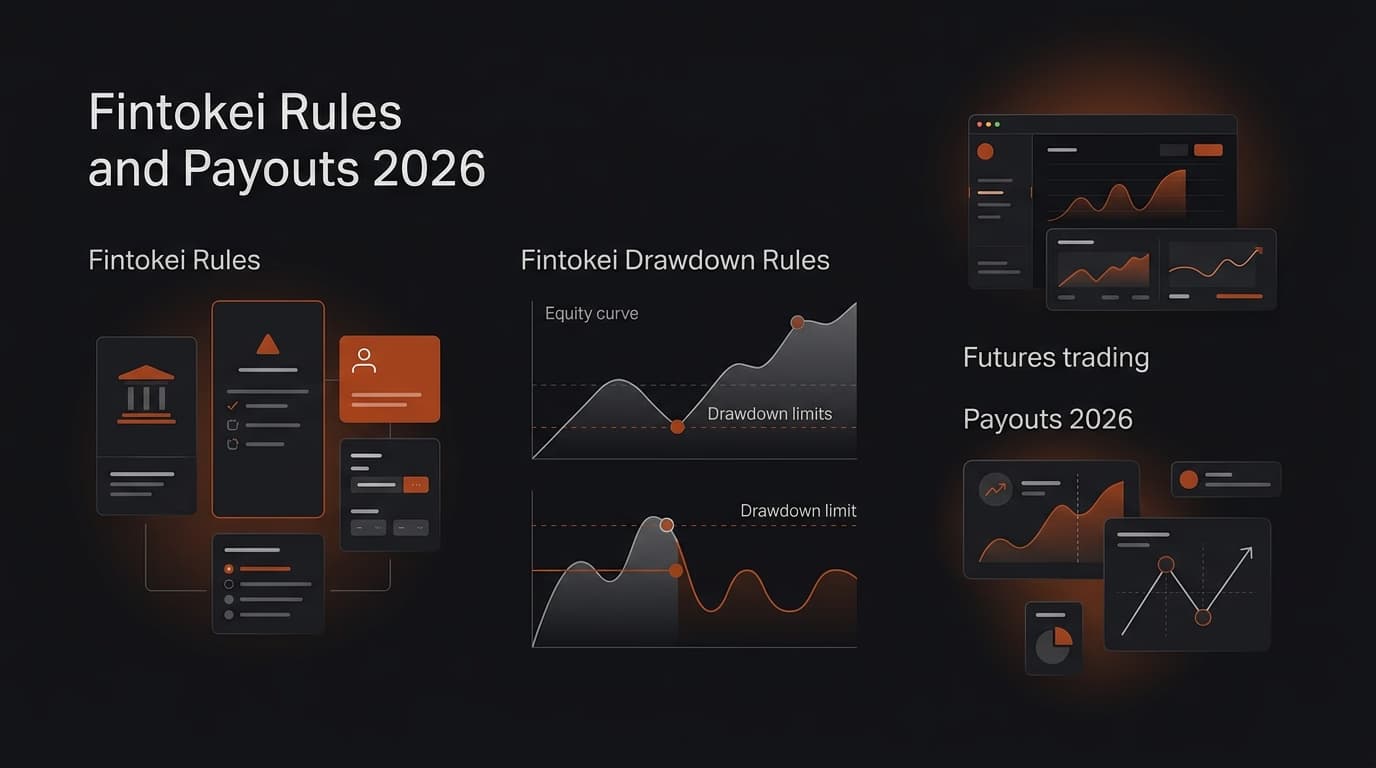
Fintokei Rules 2026: Daily Loss Limits, Drawdown Caps, and Evaluation Guidelines
Fintokei rules emphasize strict daily loss limits and maximum drawdown caps that differ by program. Traders must follow these guidelines on demo accounts to qualify for funded status and payouts. In our analysis of over 40 prop firms, Fintokei stands out for its simplified 3 percent open-risk cap introduced in April 2026.
| Feature | Details |
|---|---|
| Profit Target | SwiftTrader: 10 percent; StartTrader: 2-3-6 percent across phases; ProTrader: 8-6 percent |
| Daily Loss Limit | SwiftTrader and StartTrader: 3 percent; ProTrader: 5 percent (trailing from EOD equity) |
| Max Loss / Drawdown | SwiftTrader and StartTrader: 6 percent static; ProTrader: 10 percent trailing |
| Min Trading Days | SwiftTrader: 5 days; StartTrader and ProTrader: 3 days per phase |
| Max Risk on Open Trades | 3 percent of initial balance with graduated warnings after violations |
| Allowed Instruments | Forex pairs with news and weekend trading permitted under program rules |
These limits exist to test discipline rather than one-time gambles. The April 2026 update simplified open-risk tracking to a clear 3 percent cap on realized and unrealized losses.[1] Breaches trigger immediate disqualification on monitored demo accounts. StartTrader applies a consistency rule that caps any single day at 40 percent of the profit target.
Fintokei appears in Lune's prop firm directory alongside 47 other firms with side-by-side rule comparisons and current promo codes.
Evaluation Rules in 2026
Fintokei runs three core evaluation programs in 2026: StartTrader (3-step), SwiftTrader (1-step), and ProTrader (2-step). Each program sets clear profit targets, loss limits, and trading day minimums that traders must meet on demo accounts.
Profit Targets by Account Size
Profit targets scale with account size and program type. StartTrader requires 2 percent, then 3 percent, then 6 percent across its three phases. SwiftTrader uses a single 10 percent target. ProTrader uses an 8 percent target in phase one and 6 percent in phase two.
| Program | Account Size | Profit Target (%) | Price (USD) |
|---|---|---|---|
| StartTrader | $5,000 | 2, 3, 6 | $44 |
| StartTrader | $20,000 | 2, 3, 6 | $119 |
| StartTrader | $50,000 | 2, 3, 6 | $244 |
| StartTrader | $100,000 | 2, 3, 6 | $419 |
| SwiftTrader | $10,000 | 10 | $119 |
| SwiftTrader | $50,000 | 10 | $369 |
| SwiftTrader | $100,000 | 10 | $599 |
| SwiftTrader | $200,000 | 10 | $1,299 |
| ProTrader | $50,000 | 8, 6 | $2,440 |
Traders can apply promo codes such as NEW20 for 20 percent off first challenges or RELOAD50 for repeat attempts on SwiftTrader plans.[2]
Drawdown Rules
Drawdown limits protect both the firm and the trader. Most plans cap daily loss at 3 percent and maximum loss at 6 percent (static from starting balance). ProTrader allows a 5 percent daily limit and 10 percent trailing maximum loss. A 3 percent cap also applies to total risk on open trades or groups of ideas.[3]
Rules are monitored in real time. A first violation triggers a warning. Repeated breaches can reduce limits or trigger consistency rules. The system now uses a simple 3 percent open-risk threshold instead of complex VaR calculations.[1]
Fintokei designed these limits to reward consistent discipline rather than one large gamble. The daily cap prevents traders from treating the loss limit as a stop-loss.
Minimum Trading Days
Every program requires a minimum number of trading days. StartTrader needs three days per phase. SwiftTrader requires five days. ProTrader also requires three days in each phase. Inactivity for 30 days closes the account automatically.
Here is a worked example for a $50,000 StartTrader account. The trader must reach a 2 percent profit target ($1,000) in phase one while staying under a 3 percent daily loss ($1,500) and 6 percent maximum loss ($3,000). On day one the trader opens two positions with combined risk of $900. The account gains $1,200 by close. The daily loss never exceeds $400. The trader finishes the phase in four days, well under the 6 percent drawdown ceiling. The same math scales to the $100,000 account: targets double to $2,000 while daily and max loss limits become $3,000 and $6,000.
Lune's prop firm comparison tool lists these exact numbers alongside 46 other firms so traders can match rules to their risk style without manual spreadsheets.[4]
Trading Rules & Restrictions
Fintokei enforces program-specific rules that focus on consistency and risk control. These limits vary across StartTrader, SwiftTrader, and ProTrader challenges. Understanding each rule helps traders match their style to the right program.
Allowed Instruments
Fintokei supports forex pairs exclusively. Scalping is permitted under the scalpAllowed: Yes rule. No monthly fees apply to any program.
News Trading Policy
News trading rules are not explicitly restricted in current programs. Traders may hold positions through high-impact events, but the 3% maximum risk on open trades still applies. This limit covers both realized and unrealized losses.
Practical Impact: News traders can enter around releases, yet they must size positions so one idea never exceeds 3% of the initial balance. Swing traders face fewer timing constraints than on firms that ban news entirely.
Weekend & Overnight Holding
Weekend and overnight holding policies are not specified in Fintokei challenge details. Positions may remain open outside regular sessions provided the daily loss and open-risk limits stay intact.
Practical Impact: Overnight holders on SwiftTrader or ProTrader programs should monitor the 3% open-risk cap closely. Scalpers who close daily avoid this concern, while swing traders benefit from flexible holding but must track equity snapshots at midnight UTC for trailing drawdown calculations.
Position Limits
The key position control is a 3% maximum risk on open trades. Violations trigger warnings first, then possible account restrictions after repeated breaches. Consistency rules apply in StartTrader phases when one day exceeds 40% of the profit target.
Practical Impact: Day traders who spread risk across multiple setups stay compliant more easily. Aggressive single-position traders must reduce size or add stop-losses to avoid warnings. Lune's risk management tools can mirror these exact limits across multiple prop firm accounts for automatic enforcement.
Payout Rules & Schedule
Fintokei structures payouts to reward consistent performance across its three programs. The rules differ by challenge type, so traders need to match the details to their chosen path before starting.
Profit Split Structure
StartTrader and ProTrader accounts pay an 80 percent profit split to the trader. SwiftTrader accounts pay a full 100 percent split. These percentages apply once you reach funded status and request a payout. The split stays fixed for the life of the account.
Payout Frequency
All programs process payouts on a bi-weekly schedule. You can request a payout every two weeks once you meet the minimum profit threshold for that cycle. This cadence gives traders steady access to realized gains without long waits between requests.
Minimum & Maximum Payouts
Fintokei lists no strict minimum payout amount on most plans. The main limit comes from the first payout delay rules instead. Average reported payouts sit near $3,218, with total payouts exceeding $28 million from 2023 through 2025.
| Program | Profit Split | Frequency | First Payout Rule |
|---|---|---|---|
| StartTrader | 80% | Bi-weekly | 3-180 days after pass |
| SwiftTrader | 100% | Bi-weekly | +3% profit minimum |
| ProTrader | 80% | Bi-weekly | 3 profitable days |
First Payout Eligibility
Eligibility timing varies by program. StartTrader accounts allow the first request between 3 and 180 days after passing the evaluation. SwiftTrader requires at least 3 percent profit before the first payout. ProTrader needs three profitable days. Here is a sample timeline for a SwiftTrader account: pass evaluation on Day 1, reach the 3 percent profit mark on Day 12, and receive funds on Day 14 during the next bi-weekly window.
Drawdown rules and the 3 percent open-risk cap exist to evaluate consistency and discipline rather than luck or one-shot gambles.
Traders comparing funded programs often review multiple firms side by side. Lune's prop firm directory at /prop-firm lets you filter by split, frequency, and drawdown rules in one place. Always verify the latest terms on the firm's site, as policies can update.
Account Scaling & Progression
Fintokei structures trader growth through three distinct evaluation programs. Each program sets clear milestones before you access funded capital.
- StartTrader (3-step): Complete three phases with 2 percent, 3 percent, and 6 percent profit targets. Daily loss stays at 3 percent and maximum loss at 6 percent. Pass all phases to reach funded status with an 80 percent profit split.
- ProTrader (2-step): Hit 8 percent then 6 percent targets. Daily loss limit reaches 5 percent with a 10 percent trailing maximum loss. Funded traders keep an 80 percent split after meeting the minimum profitable days requirement.
- SwiftTrader (1-step): Reach a single 10 percent profit target. Limits remain 3 percent daily and 6 percent maximum. Funded accounts pay 100 percent of profits after the first qualifying payout.
Account sizes range from $5,000 to $200,000. You may hold multiple accounts, though Fintokei does not publish an explicit cap. The platform enforces a 30-day inactivity rule that closes any unused account.
Drawdown rules exist to test consistency rather than luck. The 3 percent open-risk cap prevents single ideas from consuming your entire daily buffer.
Recent payouts total over $28 million, with nearly half paid in 2025 alone. Average payout size sits near $3,218. Pass rates vary by program, with SwiftTrader near 10 percent and ProTrader near 21 percent.
Traders managing several funded accounts benefit from unified risk controls. Lune's prop firm tools connect to over 100 futures firms and apply daily loss limits across every account in one view. This setup reduces manual tracking while you scale position sizes or add new challenges.
Tips to Stay Within the Rules
Traders often lose funded accounts by treating drawdown limits as a safety net rather than a hard boundary. Fintokei enforces clear daily and maximum loss rules that reset or calculate differently across programs.
Common Mistakes Traders Make
- Opening multiple positions that push total risk above the 3 percent cap on open trades. The first violation triggers a warning. Three or more can lead to reduced leverage or consistency rules.
- Ignoring the 3 percent daily loss limit on StartTrader and SwiftTrader accounts purchased after December 2024. This limit applies to realized and unrealized losses combined.
- Letting one day generate more than 40 percent of the profit target in StartTrader phases. This violates the consistency rule and disqualifies the account.
- Allowing 30 days of inactivity. The account closes automatically with no warning period.
Fintokei simplified the open-risk rule in April 2026 to a straightforward 3 percent limit on trading ideas. The change replaced complex VaR calculations after trader feedback.
Practical Steps to Stay Compliant
- Set position size so no single idea risks more than 2 percent of the initial balance. This leaves headroom before the 3 percent warning threshold.
- Use the MyFintokei dashboard to monitor equity snapshots at midnight UTC for ProTrader accounts. The daily limit resets from the end-of-day equity.
- Place stop losses on every trade. The rules exist to test discipline, not to let traders use the daily limit as an emergency exit.
- Track profit distribution across days in StartTrader. Spread gains so no single session exceeds 40 percent of the target.
Traders who treat these limits as active risk controls rather than after-the-fact penalties pass evaluations at higher rates. For a full side-by-side view of how Fintokei rules compare with 47 other firms, visit Lune's prop firm directory.
- Monitor the 3 percent open-risk cap daily to avoid warnings and account restrictions.
- Respect the 40 percent consistency limit in StartTrader phases to prevent disqualification.
- Avoid 30-day inactivity gaps that automatically close unused accounts.
- Use Lune's prop firm directory to compare Fintokei rules against 47 other firms in one view.
- Apply promo codes like NEW20 or RELOAD50 to reduce first-challenge costs by up to 50 percent.
Frequently Asked Questions
What happens if I break a Fintokei rule?
Breaking a Fintokei rule such as exceeding the daily loss limit or maximum loss limit typically results in immediate account termination. Traders lose access to the funded account and any unrealized profits. Review the specific risk parameters in your account agreement to avoid violations.
Can I trade during news events on Fintokei?
Fintokei permits trading during news events provided positions stay within the maximum risk on open trades limit. Sudden volatility can quickly breach drawdown rules so strict position sizing is required. Always monitor the high-water mark parameters during high-impact releases.
How often can I withdraw profits from Fintokei?
Funded traders can request profit withdrawals on a regular schedule once the account meets all performance targets. Payout frequency depends on the specific program but is typically available after each successful trading period. Confirm current payout timelines directly in your trader dashboard.
Does Fintokei have a consistency rule?
Fintokei does not enforce a strict consistency rule on profit targets or lot sizes. Traders must still respect the simplified risk management system and daily loss limits at all times. Focus on steady risk management rather than artificial consistency metrics.
What is the maximum payout from Fintokei?
Fintokei offers profit splits up to 80 percent on funded accounts with no fixed cap on total earnings. The maximum payout amount scales with account size and consistent performance. Payout requests are processed after verification of all trading rules.
Did Fintokei change their rules in 2026?
Fintokei simplified its risk management system in recent updates but core rules around loss limits remain unchanged for 2026. Daily and maximum loss calculations continue to use the same high-water mark method. Check the latest support articles for any minor adjustments.
Can I hold positions overnight with Fintokei?
Overnight position holding is allowed on Fintokei accounts as long as the maximum risk on open trades is not exceeded. All positions must comply with the daily loss limit at the start of each trading day. Monitor drawdown levels closely when carrying trades past market close.[3][5][6][7]
Sources
- 1How are the Daily loss limit and Maximum Loss limit calculated? | Fintokei FAQssupport.fintokei.com
- 2
- 3What is the maximum risk on open trades? | Fintokei FAQssupport.fintokei.com
- 4
- 5
- 6
- 7What rules do I have to follow to keep my StartTrader account? | Fintokei FAQssupport.fintokei.com
- 8How Fintokei Loss Limits Workfintokei.com
Lune Research & Editorial Team
The Lune Editorial team covers futures trading, prop firm evaluations, automation, and the trading-tooling landscape. Every post is researched against primary sources, real platform data, and Lune's own infrastructure benchmarks.
Published: October 2, 2026
Compare All Prop Firms on Lune
Independent reviews, real challenge data, and exclusive promo codes for 20+ prop firms, all in one place.
Compare Prop FirmsThis post may contain affiliate links. We earn a commission at no extra cost to you.